Raivin Quick Start
Introduction
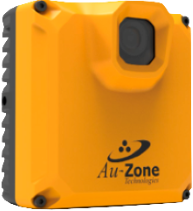
The Raivin configuration further extends the perception capabilities of the Maivin platform through the addition of the integrated radar module or LiDAR module. The EdgeFirst Perception Middleware is augmented for Raivin configurations with the fusion service which projects the radar and LiDAR point clouds onto the vision model output to classify targets, produce 3D bounding boxes, and an occupancy grid. The EdgeFirst Fusion Model additionally provides low-level radar data fusion with the vision data. The low-level radar data is represented as the range and doppler data cube, the EdgeFirst Fusion Model fuses this data with the vision data to provide a more robust perception stack. The traditional point-cloud data from the radar is also available for use by the Raivin perception stack, and is especially useful for augmenting the object detection and tracking capabilities through the additional parameters offered by the point cloud data.
System Overview
The Raivin runs a Linux operating system based on Toradex's Torizon OS 7, we refer to the operating system as Torizon for Maivin. The operating system packages include common libraries and tools you would expect to find on a typical embedded Linux operating system focused on computer vision and AI (Python, OpenCV, GStreamer, etc...) along with the Docker container engine for user applications. Refer to the Release Notes for the versions included in the current release and the Software Updates for keeping the platform up to date.
Central to the EdgeFirst Platforms is the EdgeFirst Perception Middleware, what we call our collection of applications and libraries used in the implementation of the perception stack. On the Raivin these applications run natively as systemd services, the radar or LiDAR publisher and the fusion service are enabled during provisioning in addition to the base Maivin services. The details of the low-level libraries are covered in the EdgeFirst Perception Developer Guide, for this document we focus on describing the application services and how they fit together to deliver the perception middleware.
Quick Start Overview
In this Quick Start, you will find instructions for:
- Setting up your Raivin
- Recording an MCAP using the Raivin
- Uploading the MCAP to EdgeFirst Studio
- Creating a project in EdgeFirst Studio
- Restoring the MCAP into a Dataset
- Annotating the Dataset
- Splitting and Tagging the Dataset for Training
- Training a Fusion Model
- Validating the Fusion Model
- Deploying the Fusion Model
Each page links to the next, so you can also just start with Setup and follow the trail through to deployment. For a tour of the device's main page, see the Web UI Walkthrough. Please note that this Raivin Quick Start guide only includes Fusion Model training for 3D models; the Maivin Quick Start contains the steps on how to train, validate, and deploy 2D models.